


When adding extensions or filling gaps in historic ensembles, planners face a practical challenge: the new building must blend harmoniously into its surroundings, yet it should not appear to be artificially historicized; it must remain recognizable as a modern building.
The solution to this planning dilemma—the transition from old to new—often lies in the materials used for the façade. However, finding the exact shade and the right texture is not always easy in practice. Especially when historic preservation authorities are involved in the project, the choice of materials requires a great deal of tact. The authorities have the understandable goal of preserving the established character of a complex. For architects, this often means an intensive coordination process: the goal is to jointly find a design consensus that respects the historic fabric while still allowing for a distinctive architectural identity.
Two real-world approaches demonstrate that old and new are not mutually exclusive, but rather complement each other effectively through the right choice of materials.
From a smooth transition to a monolithic unity
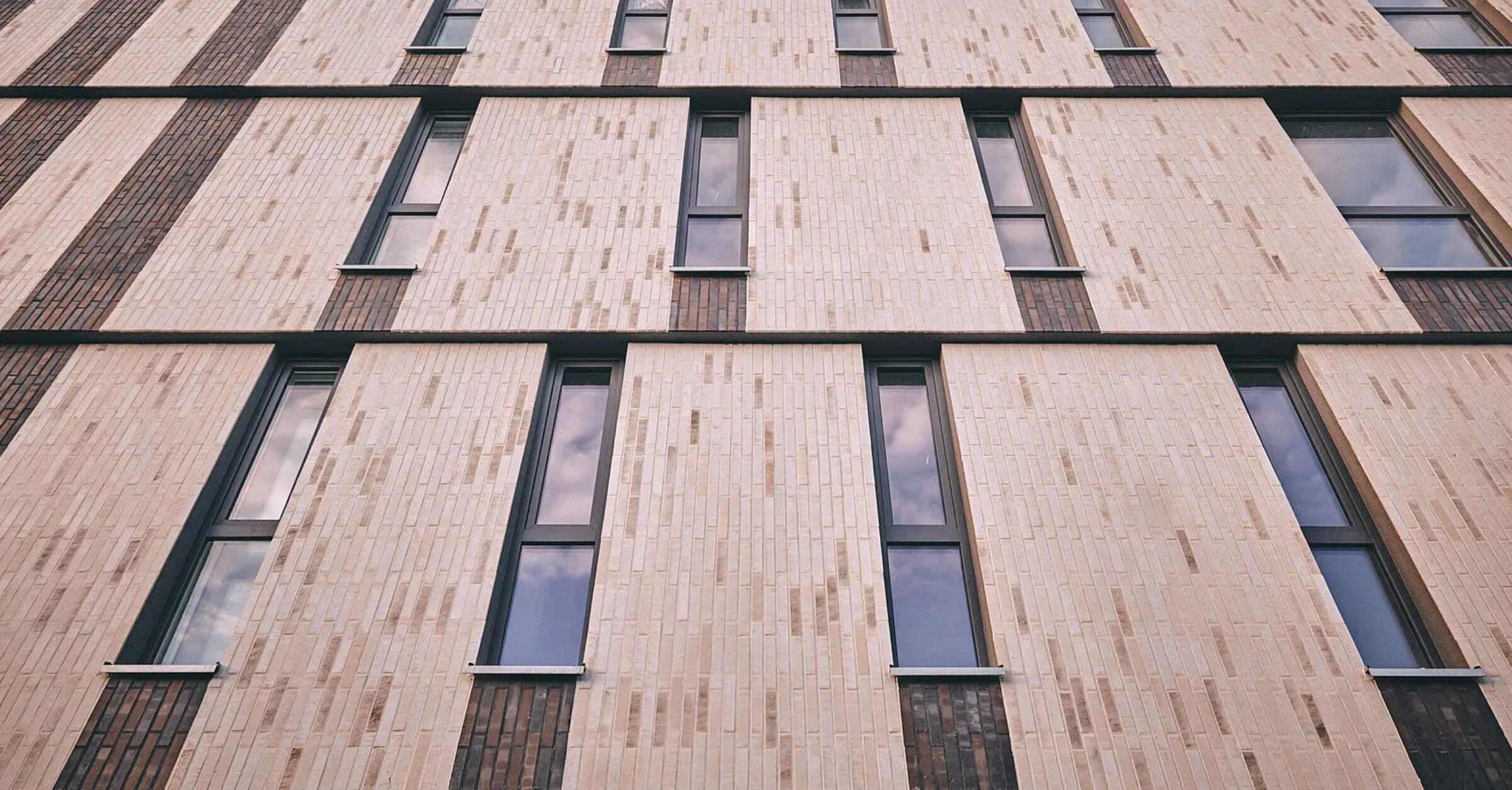
The town hall in Brühl demonstrates how a modern clinker brick façade can be elegantly integrated into a historic setting. JSWD Architects were commissioned to replace a 1960s building—directly adjacent to the historic existing structure. One of the connecting elements is the “Weimar” series. The clinker brick echoes the light hue of the neighboring building envelope, thus blending modernity and tradition. From a distance, the façade appears understated and harmonious; upon closer inspection, the brick introduces a subtle variety to the façade: beige-fired clay with a white patina, red accent bricks, and bricks with coal dust deposits.
Toward Steinweg, where the Wilhelminian-style façade seamlessly transitions into the modern building envelope, the architectural team created a gentle transition with a similarly structured perforated façade. At the end and on the side facing Jahnshof, the façade’s appearance changes. Large-scale filter masonry creates a connection between interior and exterior on the staggered sections of the building. With this visual transformation, JSWD responds to the building’s use: while office spaces are concealed behind the perforated façade, the filter masonry creates a pleasant lighting atmosphere in the city library, which is located in the same building.
The new building’s massing draws inspiration from the historic town hall, yet it develops its own form based on the proportions of Brühl’s old town. The staggered gabled roofs are also entirely clad in light-colored Weimar clinker brick, further emphasizing the building’s uniformity.
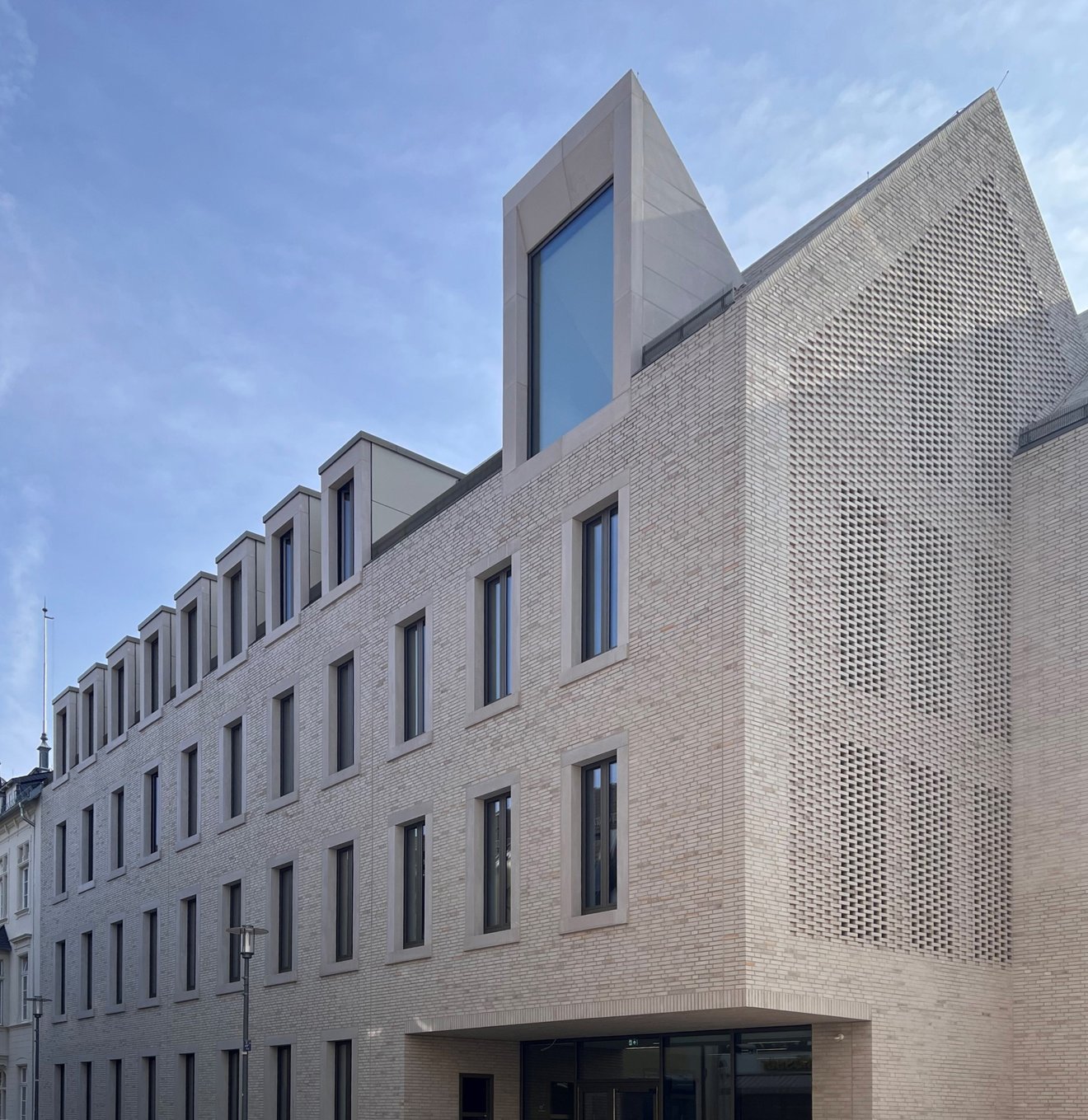
Foto:
Distance and dialogue in the maxfrei neighborhood
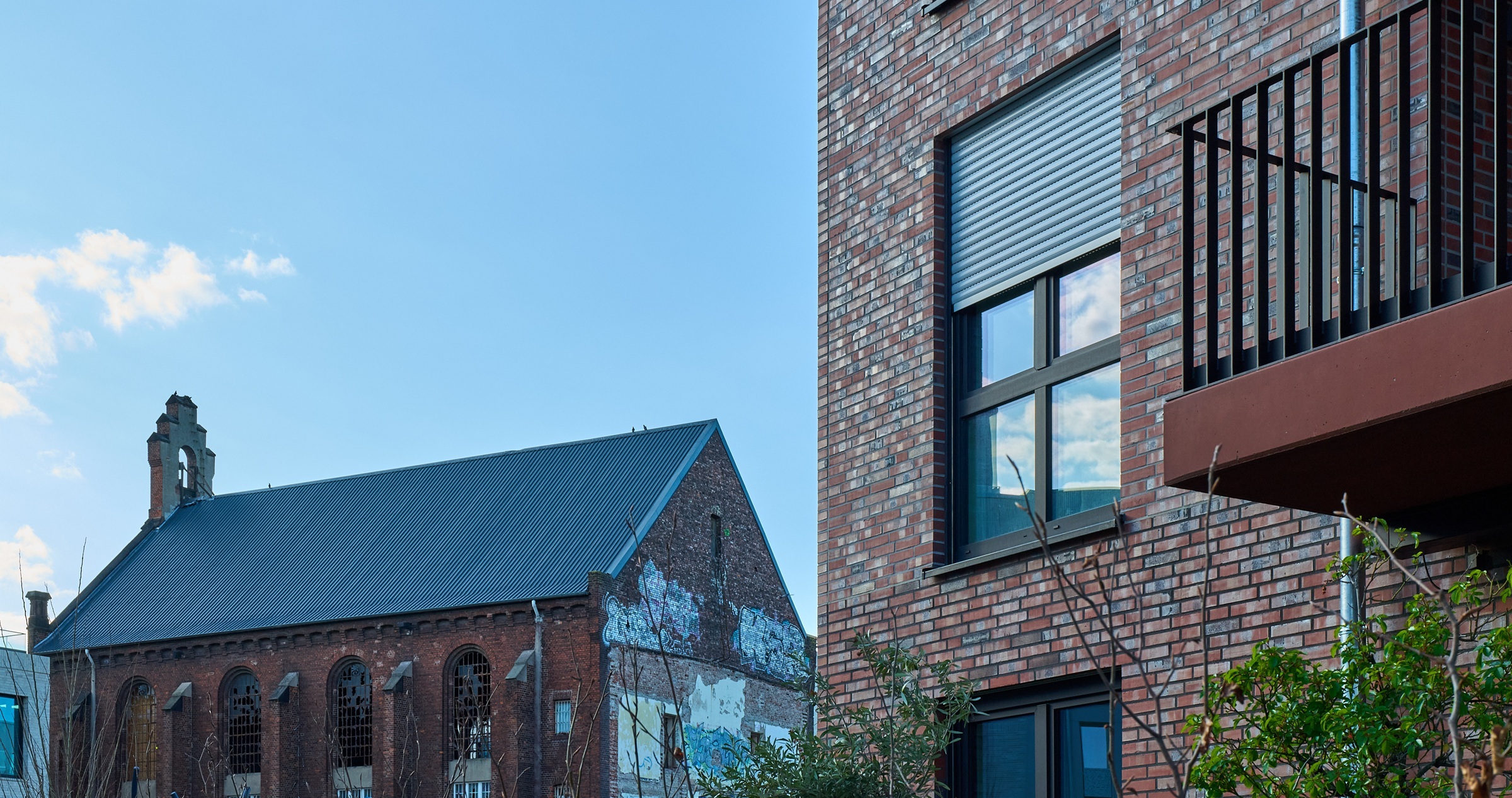
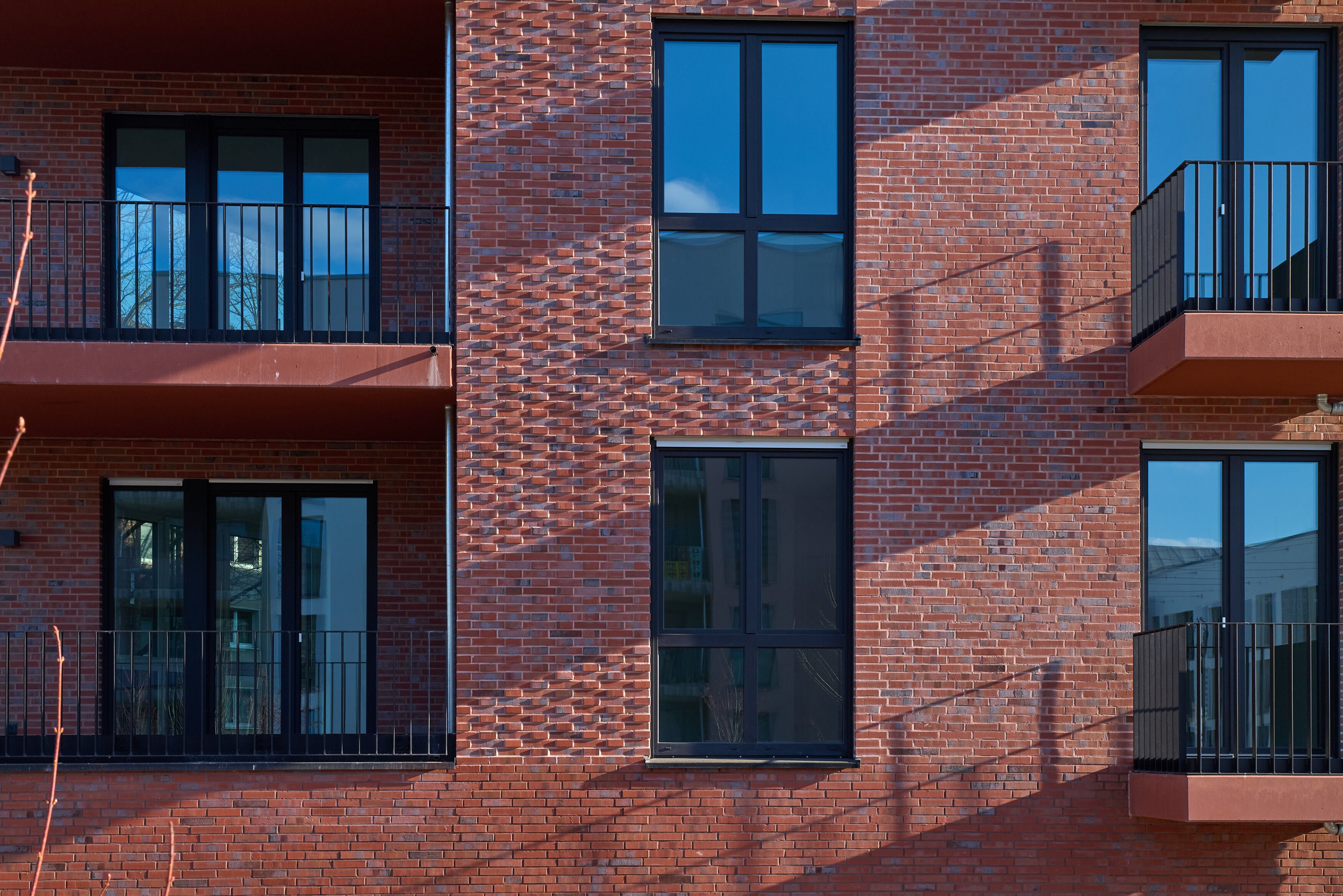
In the maxfrei district of Düsseldorf, the spatial relationship between the historic buildings and the new construction was somewhat more expansive. Here, an old chapel within sight—formerly part of a correctional facility—served as a visual anchor. Its striking red brickwork provided HPP Architects with the key design inspiration for the new buildings in Building Plot 3.
The planning team’s design concept envisioned a reddish overall ensemble composed of various building sections. These segments were intended to visibly differ from one another in their nuances, yet ultimately merge into a harmonious whole.
For the implementation, the choice fell on the three Hagemeister ranges Liverpool GT, Schleswig GT, and Krefeld GT in a thin format. To enhance the diversity and vibrancy of the surfaces, the architects varied the joint colors and integrated three-dimensional diamond patterns as well as reliefs. A particular advantage in terms of production technology: Since the clinker brick slips used were custom-cut at the factory from whole bricks to the exact required thickness for each project, even such sophisticated, three-dimensional facade details could be realized with brick slips without compromise.
Format, composition, and joint as design tools
The examples show that choosing the right stone is only the first step in the design process. Even when an extension uses clinker bricks that are similar in color to those of the historic building, the design possibilities are vast. Here, the brick size and joint become crucial design elements. A deliberate switch to a modern long format, the choice of a different masonry bond, or the use of a deep shadow joint give the new façade a completely different sense of depth. The color scheme visually unifies the ensemble, while the details anchor the new building in the here and now.
Conclusion: Planning reliability when renovating existing buildings with clinker bricks
Whether it’s an addition or a new building within sight of a historic landmark: when the texture, size, and color nuances of the clinker bricks are precisely matched to the existing structure, the result is a façade that meets the approval of historic preservation authorities and enhances the cityscape in a lasting way. Early engagement with the material and the creation of sample walls save architectural firms valuable time and ensure the design quality of the project.